
Fugitives
We have all heard that dreaded word at some point in our painting career. But what does it mean? How do I know if I’m using a fugitive colour? It always seems to be the unanswered question!
What is a fugitive and why do they exist?
In history the standards set for pigments was not as important as it is to us now. As time went on pigment manufacturers experimented with different chemicals and natural substances to make even better and more reliable pigments.
During the impressionist period the demand was for bright and vivid colours. However, many of these bright pigments were still fugitive, unreliable and faded badly. The most unreliable were red lakes, madders, carmines, purples, red leads and chrome yellows. A great deal of historic paintings look very different today than when they were first painted because of this. The few more reliable pigments that were made were much more expensive and some famous artists just couldn’t afford them. It was the same for oil colours.
Vincent van Gogh favoured a vivid palette of colours and most of his paintings have faded. His ‘Sunflowers’ painting is a prime example of a fugitive yellow pigment, chrome yellow, which fades to brown in sunlight. Today the flowers look brown. You can see his paintings on this link: www.vangoghmuseum.nl/en/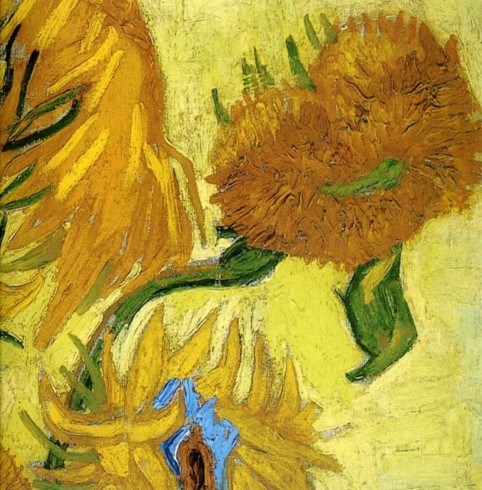
In Victorian times new chemistry developed synthetic prismatic and brighter colours but a lot of these were still fugitive.
It wasn’t until 1984 that the standards became stricter with the introduction of testing. Nowadays, permanency and lightfast ratings are available for all pigments but there are still some to be aware of. Ratings for artists’ use are A, AA, I and II (companies who use asterisks or stars differ and are detailed in the company pigment lists further on). Anything less than this will not be as reliable for lightfastness. All this information can be found on watercolour company charts or online via their websites. See list of standards below:
I – Very lightfast
II – Good lightfast
III – Average lightfast
AA – Extremely permanent
A – Permanent
B – Moderately durable
C – Fugitive
V – well don’t go there!
n.r. – Not rated by ASTM
I, II ratings are given by the ASTM (American Society for Testing Materials). The society started testing pigments in 1984 to set standards for the performance of art materials, including lightfastness. Winsor & Newton use both ASTM and permanence ratings. In the ASTM system ‘I’ is the highest lightfastness available and ‘V’ is the lowest. Pigments that are not rated by ASTM or the companies who make them bear the symbol n.r.
A, AA – The Winsor & Newton permanence classifications measure not only lightfastness but also general stability of the pigment.
I have made a small A6 chart with all these rating symbols plus transparency symbols for you to download here. Watercolour-rating-symbols Keep it handy!
Which pigments should I be wary of?
W& N professional
Alizarin Crimson (B) – as we learned last month Permanent Alizarin Crimson is good, this is lightfast A
Rose Madder Genuine (B)
Opera Rose (B, really a C!)
Aureolin (II – PY40 this fades to brown despite being rated II)
Daniel Smith
Opera Pink (IV)
Alizarin Crimson (IV)
Aureolin (II – PY40 this fades to brown despite being rated II)
Sennelier
Helios Purple (III)
Dioxazine purple (III)
Quite a few Sennelier pigments are not rated. It’s best to test them yourself to be sure.
Schmincke
Symbols vary for Schmincke colours, they are as follows:
***** extremely lightfast, **** good lightfastness, *** lightfast, ** limited lightfastness, * less lightfast, – not lightfast
Alizarin crimson (*)
Madder lake deep (**)
Rose Madder (**)
Schmincke violet (**)
Indigo (**)
Olive green (**)
These Brilliant pigments are not rated, would avoid:
Brilliant red violet
Brilliant opera rose
Brilliant purple
Brilliant red violet
Brilliant blue violet
Daler Rowney
Symbols vary for Daler Rowney, they are as follows:
**** Permanent, *** Normally permanent, ** Moderately permanent,
* Fugitive
Aureolin (** PY40)
21 colours offer ****
56 colours are rated ***
White Nights
Symbols vary for White Nights colours, they are as follows:
*** high lightfast, ** medium lightfastness, * low lightfast
Hanza yellow (*)
Orange lake (*)
Scarlet (*)
Claret (*)
Rose (*)
Vermillion (*)
Violet rose (*)
Violet (*)
Blue lake (*)
M. Graham
Alizarin crimson (III)
Below is a lightfastness test I did for Opera Rose and Quinacridone Magenta over a two year period (2017 left side and 2019 right side). The Opera Rose is still bright but all the florescent additive has disappeared making it look less intense in colour. The Quinacridone Magenta (PR122) has not altered. The Winsor and Newton (Opera Rose) and Daniel Smith (Opera Pink) versions of this vivid pink are the most reliable across brands using PR122. Both have added fluorescence.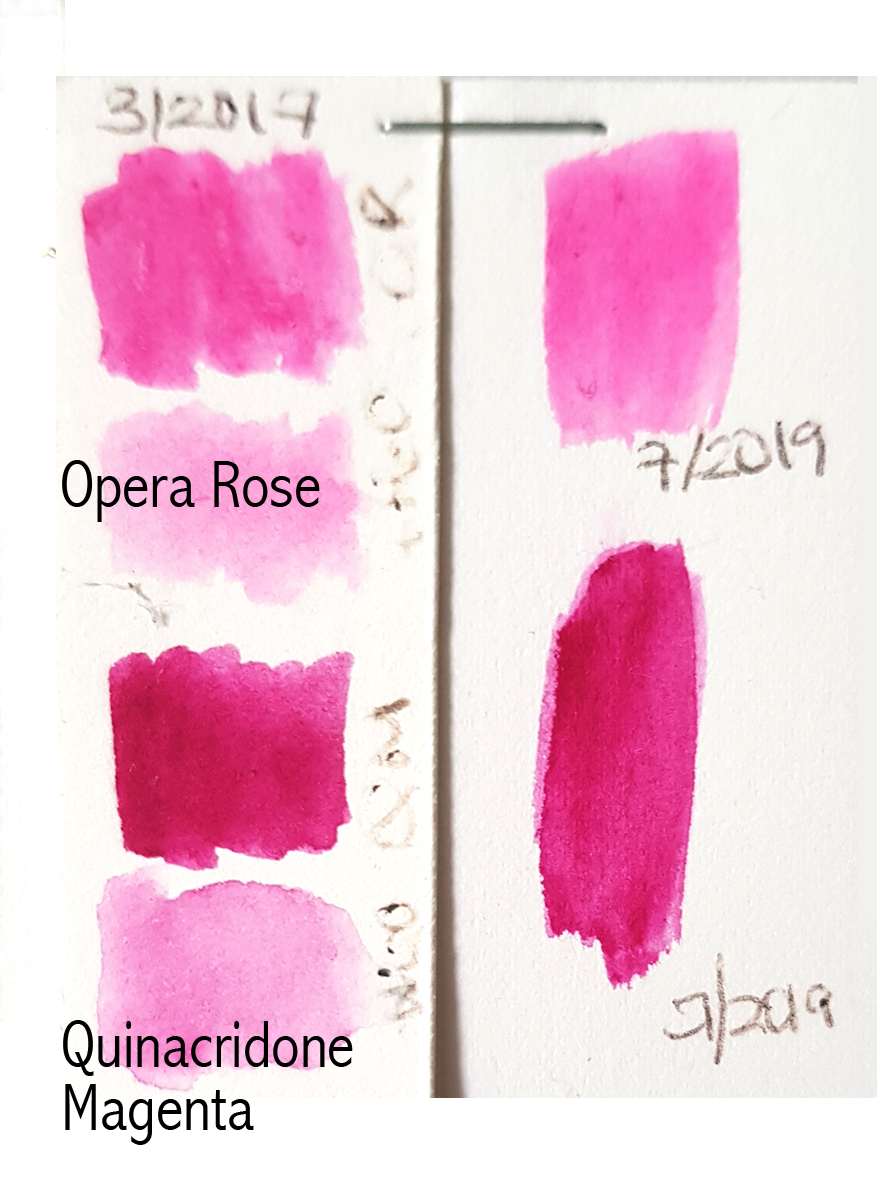
If painting for an exhibition where your work will be for sale, always use lightfast pigments. If you have to use a pigment which is less permanent then ensure you put a label on the back of your framed painting stating not to hang it in direct sunlight.
I recommend watching the Winsor and Newton video ‘Masterclass on Colour Permanence’ to see how a simulated 100 year lightfast test changes these fugitive colours; Rose Madder Genuine, Alizarin Crimson and Opera Rose. Here is the link: www.winsornewton.com/uk/masterclass/permanence-in-colour/
So, the secret is to always check the watercolour company rating charts before you buy or look for the ratings on tubes or pans as you shop! If in doubt colour test the pigment by painting it onto watercolour paper and leaving it on a really sunny windowsill for at least 3-6 months.
I hope this blog has answered a few questions for you. Please share it to help others too! Thank you.
Happy painting and see you next month!

Email address:jackieisard@googlemail.com
Facebook:https://www.facebook.com/jackieisardbotanicalnaturepainting/
Instagram: @jackieisard
Blog: https://jibotanicals.com/
Web: https://www.jibotanicals.co.uk/
Etsy shop: https://www.etsy.com/uk/shop/jibotanicalsGifts

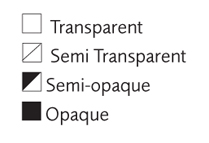 Here I have split some of the W&N blues into categories. The permanency, lightfastness and transparency ratings are under each colour:
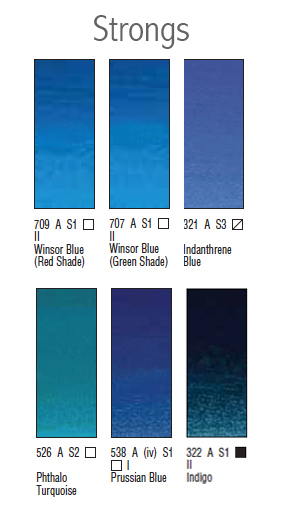 Strongs – those which have greater intensity of pigment, you’ll need less when mixing!
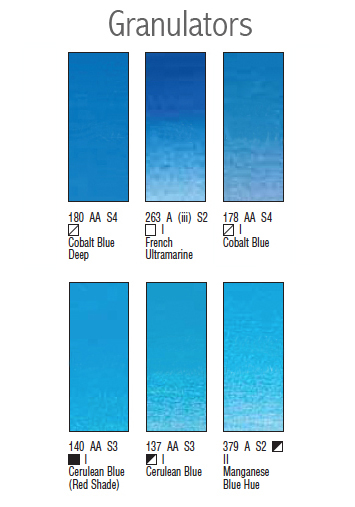 Granulators – those which granulate, not good for smooth rendering! Some of them will granulate more than others. Cobalt Blue isn’t as grainy as French Ultramarine. However, Ultramarine Green Shade shows very little granulation, but it does have a very slight green bias compared to French Ultramarine. I like the intensity of this pigment compared to French Ultramarine though.
Cerulean is a particularly granulating pigment and semi-opaque. If used as an underlayer, you will not achieve a smooth see-through effect with it. It is good for textured style painting though. See the image below for a comparison. Hopefully you can see it as this was quite hard to photograph! The difference is more obvious in real life. Try it out and see for yourself.
Granulators – those which granulate, not good for smooth rendering! Some of them will granulate more than others. Cobalt Blue isn’t as grainy as French Ultramarine. However, Ultramarine Green Shade shows very little granulation, but it does have a very slight green bias compared to French Ultramarine. I like the intensity of this pigment compared to French Ultramarine though.
Cerulean is a particularly granulating pigment and semi-opaque. If used as an underlayer, you will not achieve a smooth see-through effect with it. It is good for textured style painting though. See the image below for a comparison. Hopefully you can see it as this was quite hard to photograph! The difference is more obvious in real life. Try it out and see for yourself.
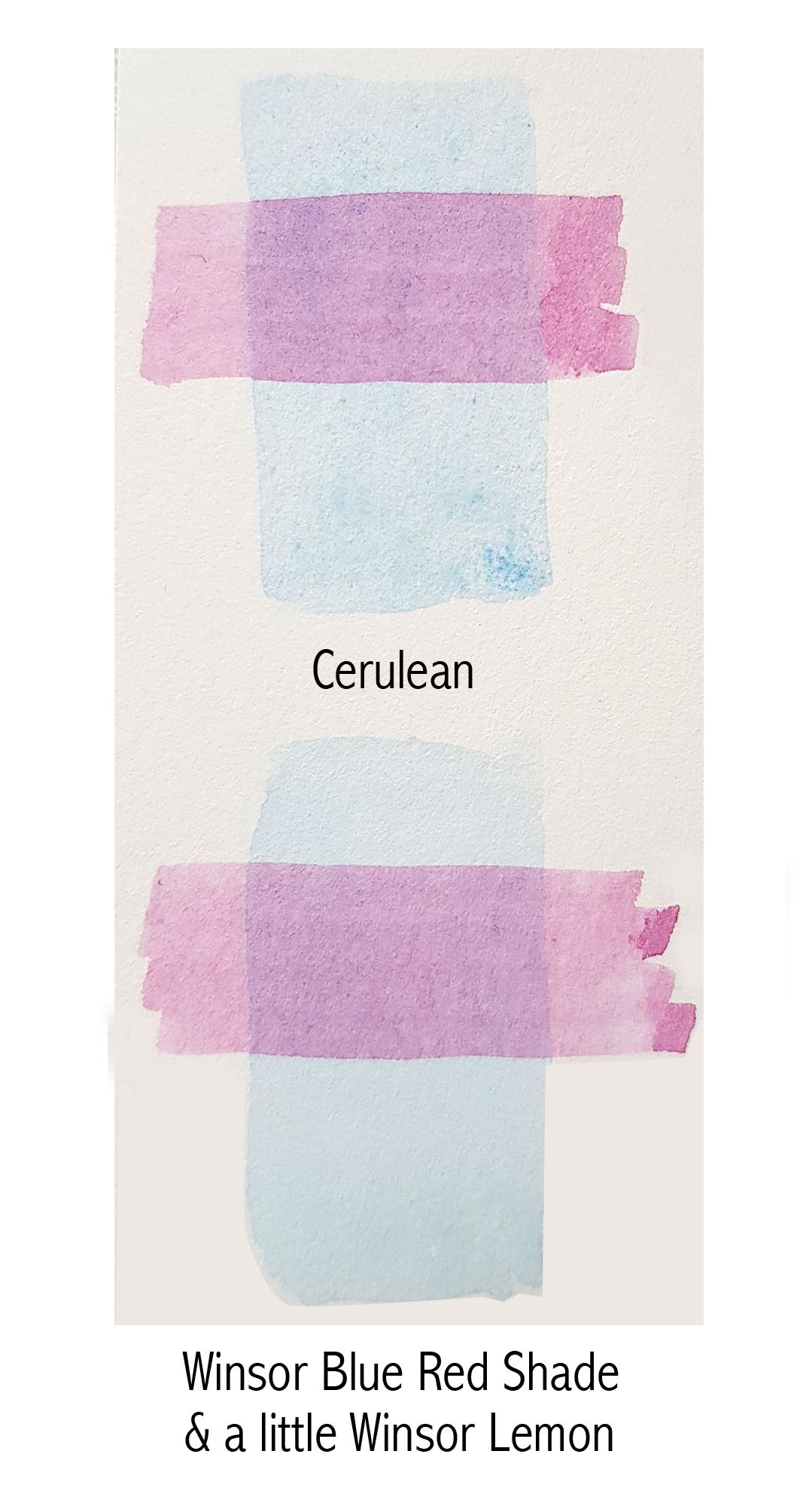 As seen above, a purple overlay was painted over base layers of Cerulean and Winsor Blue (Red Shade). The purple mix overlaid is a transparent mix. As you will see in the Cerulean example, it appears less crisp and quite mottled by the granulation. It also looks a little flatter where transparency is concerned. The Winsor Blue (Red Shade) underlay appears crisper and more see-through. So, if you are looking for a lighter blue underlay but with a slight yellow bias, just add a teensy bit of Winsor Lemon to Winsor Blue (Red Shade) and you will have a lovely smooth Cerulean look-alike!
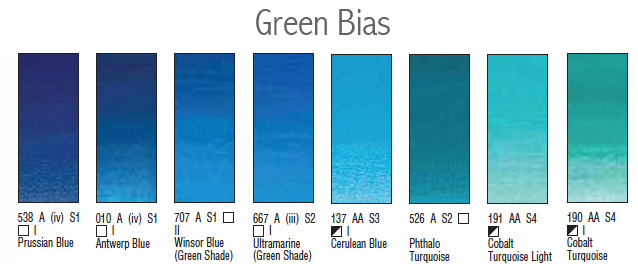 Green bias – those which will cool a mix or are more green in appearance. Further along the image above are the very green bias blues, turquoise. The greener a blue is, the more vivid it will be when mixing greens. It will need to be tamed by adding a tiny bit of red to make a more natural mix. Add Quinacridone Red (QR) to Phthalo Turquoise (PT) and you will make a muted purple/mauve/burgundy because of the green bias. Add QR to Ultramarine Green Shade (UGS), a less green biased blue, and you will make brighter purple and mauve. This is because the green bias adds more yellow to the mix muting it down. Yellow and blue make green (green/blue), plus red makes brown!
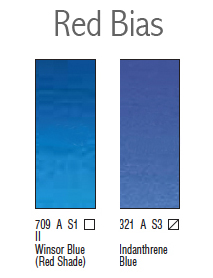 Red bias – those which will add warmth a mix. Add Transparent Yellow to a red bias blue and you will make more natural greens. Add it to Winsor Blue (Green Shade), a green bias blue, and you will make vibrant but less natural emerald greens. Red will need to be added to tame these mixes.
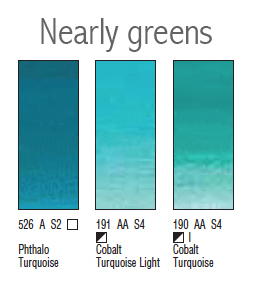 Nearly greens – those which have a definite green bias. You will notice above that Cobalt Turquoise and Cobalt Turquoise Light are semi-opaque. They also granulate. I would only use these for textured, looser style painting.
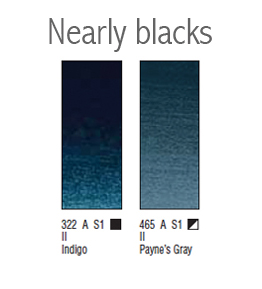 Nearly blacks – those blues which are very dark pigments with a blue bias. Notice also that both Indigo and Payne’s Grey are opaque and semi-opaque. These pigments contain black which gives them their opacity. Both have the same colour index numbers – PB15 • PBk6 • PV19 but in different proportions. The black colour index will make a mix dense and flat looking. These pigments are only useful in extremely dark areas although darkening a mix is much better using transparent or semi-transparent primaries. If done this way, it will still have a see-through feel despite being almost black.
My underlay blue choices
My favourite blues for underlaying are Winsor Blue (Red Shade), French Ultramarine and Cobalt Blue. Winsor Blue (Red Shade) is particularly good when watered down as it is really smooth. It is a lovely bright red biased blue. Make sure you paint it on very pale though as it is one of the stronger pigments. It is also one of my favourite blues to mix with. French Ultramarine, although it granulates, when used very thinly it adds a nice coolness. It is a blue with little to no bias. It is great for edging highlights on dark coloured leaves like holly. Cobalt is a lighter blue which also granulates a little. Again, used thinly, it adds a nice coolness to the layers above.
Well that’s it for this month! If you like, please do message me with any suggestions of which colours you’d like to discuss next.
Until the 24th of next month, I hope you all have a great August. Maybe even have a break and be able to spend a few days away from home!
Nearly blacks – those blues which are very dark pigments with a blue bias. Notice also that both Indigo and Payne’s Grey are opaque and semi-opaque. These pigments contain black which gives them their opacity. Both have the same colour index numbers – PB15 • PBk6 • PV19 but in different proportions. The black colour index will make a mix dense and flat looking. These pigments are only useful in extremely dark areas although darkening a mix is much better using transparent or semi-transparent primaries. If done this way, it will still have a see-through feel despite being almost black.
My underlay blue choices
My favourite blues for underlaying are Winsor Blue (Red Shade), French Ultramarine and Cobalt Blue. Winsor Blue (Red Shade) is particularly good when watered down as it is really smooth. It is a lovely bright red biased blue. Make sure you paint it on very pale though as it is one of the stronger pigments. It is also one of my favourite blues to mix with. French Ultramarine, although it granulates, when used very thinly it adds a nice coolness. It is a blue with little to no bias. It is great for edging highlights on dark coloured leaves like holly. Cobalt is a lighter blue which also granulates a little. Again, used thinly, it adds a nice coolness to the layers above.
Well that’s it for this month! If you like, please do message me with any suggestions of which colours you’d like to discuss next.
Until the 24th of next month, I hope you all have a great August. Maybe even have a break and be able to spend a few days away from home!


