Blog 3: RHS sketching adventures…

I decided to use a sketchbook to learn about and paint the plants I may choose to paint for the RHS in 2019.  Firstly I researched wildflower plants which are under threat or declining as I wanted to relate them to my concern for our wildlife and the importance of reinstating meadowland. I discovered that some of the wildflower species were quite well known and many rare insect pollinators really depend on them.

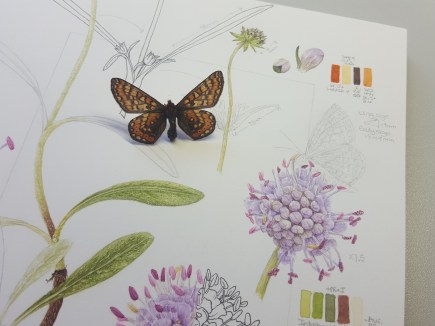
Horseshoe vetch – Hippocrepis comosa

The first wildflower I began to study was Hippocrepis comosa (Horseshoe vetch). To my delight I found it growing in the meadow behind my house. Excitedly I looked it up in my Wildlife Key book only to find that there are many similar vetches and that this one was not Horseshoe vetch! I had found Lotus corniculatus  (Bird’s-foot trefoil).  The differences are quite obvious when you know what you’re looking at and it’s always wise to check your species carefully in a good wildflower book first.

‘The Wildflower Key’ was recommended to me as a good resource book. I also own the ‘Collins Wild Flower Guide’ which has lovely illustrations.

I went walking again in the meadow and discovered another vetch, again excited I checked it in my book but now I had found another vetch called Lotus tenuis (Narrow leaved Bird’s-foot trefoil – picture 4 below). I searched on holiday in Scotland, at other meadows in Bannerdown and Box Farm. Still I could not find Horseshoe vetch! Notice the beautiful red colour in the young flowers in picture 2. I will look again next year but have also planted some seeds in my garden and the back meadow in the hope that one will grow for me to paint.

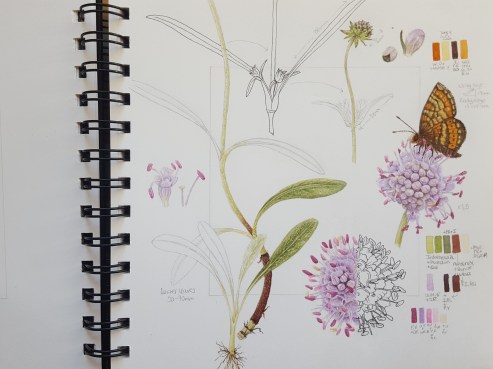
With a little more research and the help of existing botanical paintings, photographs online and my wildflower key book, I began to compose my page dedicated to Horseshoe vetch. I did not rely on photographs, as they can enhance colours incorrectly, to make my colour swatches but picked a piece of the two vetches I found in our meadow and took references from those. All 3 vetches have very similar colouring.


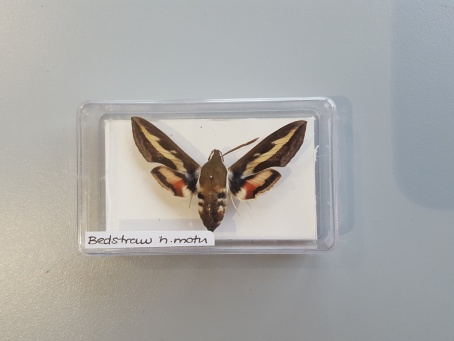
I included an Polyommatus bellargus (Adonis Blue) in my sketch as this butterfly is in major decline and Horseshoe vetch is an essential plant for both the Chalkhill and Adonis blue butterflies as their caterpillars feed solely on it. I used a set specimen I had bought and photo reference for positioning.

I studied the flower heads and seed pods too. My composition seemed like it was blowing in a summer breeze so I put a couple of meadow grasses in the background to add to this movement.

Now it was painting time! As you know I had taken my colour swatches from some suitable live subjects and so I began to mix up my colours . I placed them on the page together with a note of the colours I had used, this I will use for reference when the time comes to paint the final painting. The wings of an Adonis Blue have an iridescence to them and for this I laid a layer of Daniel Smith Iridescent Lilac over the blue part of the wing. You can just about see it in the photo below.

The final sketch included some pencil and black fine liner pen work as well as watercolour painting.

20160818_150715
Where does the plants name come from? The name Horseshoe vetch is derived from the pea like flowers which are arranged is a horseshoe shape. The seed pods have also been described as resembling a horseshoe shape. In folk law it was said that if a horse trod on it, it would be unshod.

Ragged Robin – Lychnis flos-cuculi

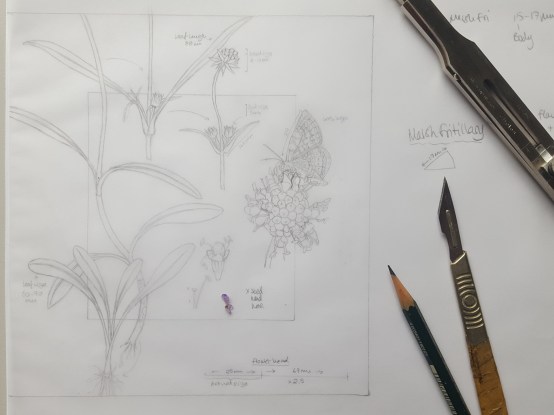
The second plant I chose to study was Lychnis flos-cuculi (Ragged Robin). I chose this plant as it is declining in numbers and for the insect pollinator I chose a Bombus sylvarum (Shrill Carder Bee) which is also becoming rare. For this plant I studied a live specimen because luckily one had grown in my garden this year from seeds planted in the Spring. I was able to study it fully and dissect parts too. (*The photo of Bombus sylvarum was borrowed from Wikipedia as I did not have a specimen. They are slightly darker than this image and 10-15mm in size)

Mixing the pink was very tricky as it is a beautiful pale pink but bright as well. I tried a few mixes and found that Daniel Smith Opera Rose, W&N Permanent Rose and a little bit of Aureolin made the perfect pink. I then took more colour references and placed them onto my sketch page. The composition began to develop showing some of the inner flower detail, seed head and a close up of the hairy stem.

Later in the sketch I decided to study the flower’s internal structure more carefully and did a few diagram style illustrations to show this. This was my final sketch page.

20160818_150628

Where does the plants name come from? Apparently this flower was used as a remedy for jaundice, stomach aches, toothache, headaches and muscular strains. The latin name ‘Lychnis’ comes for the greek work for ‘Lamp’. Flos-cuculi means ‘Cuckoo flower’. This is because it comes into flower when  the cuckoo first starts to call. It has a rather straggly and messy in appearance but don’t get it wrong as it is the food plant of long tongued bees, butterflies love it and several species of moth.

Devil’s-bit Scabious – Succisa pratensis

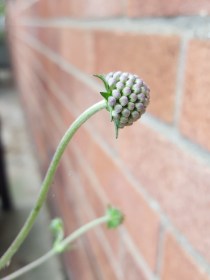
The next wildflower I plan to study is a Succisa pratensis (Devil’s-bit Scabious) and there’s one in my garden just about to open! I’m really looking forward to studying this beautiful little plant.
20160818_181142
Where does the plants name come from? The history behind this flowers name is quite interesting. “Scabious flowers were used to treat scabies, and other affictions of the skin including sores by the Bubonic Plague. The work ‘scabies’ comes from the Latin word ‘Scratch’ (scabere). The short black root was in folk tales bitten off by the devil, angry at the plant’s ability to cure these ailments.” Hence the name Devil’s-bit Scabious.

Yesterday our beautiful meadow was cut, so until next year I will have to await possible new species growing there, let’s cross our fingers!!

I hope you enjoyed this Blog and look forward to sharing my next one with you very soon!

*All photos, content, text and videos are subject to copyright – Jackie Isard Botanicals 2017
Blog 2: Insect adventures…

Alongside my Meadow wildflower studies I am also studying and painting insect pollinators. Pollinating insects are crucial to the environment. Some meadow plants rely on only one type of insect for pollination and some insects need one type of plant to lay their eggs on. If these plants or insects die out, we not only lose the plant but the insect pollinators too!

This is the reason why I feel so strongly about this subject and have chosen to highlight it for my RHS project…..

Plantlife International’s ‘Save our Magnificent Meadows’ project:

“There were once natural wild flower meadows in every parish – today only 2% of the meadows that existed in the 1930’s remain. Nearly 7.5 million acres of wildflower meadow have been lost so far and they are still being destroyed……… The Save our Magnificent Meadows project will protect, conserve and restore wildflower meadows and other grasslands across the UK, and will focus on the Fermanagh grasslands of Northern Ireland, the pastures of west Wales, Scottish grasslands from Edinburgh to Aberdeenshire, the calaminarian and whin grasslands of Northumberland and traditional meadows and pastures in Southern England.”

Rosie Maple of Avon Wildlife Trust:

“The B-lines (Biodiversity lines) project’s main focus is connectivity of high quality pollinator habitat. Wildflower grasslands and meadows are one of the most biodiverse habitats you can find in the UK. We have lost over 97% of them in the UK since the 1950’s. It’s a pretty staggering figure. Part of the main problem of conserving pollinating insects is that many species are not highly mobile. Many species of bees, butterflies, flies and beetles expend huge amounts of energy on flight and need to have a very efficient foraging strategy in order to ingest enough nectar/pollen to maintain this. So in effect they need to ‘know’ that any journey they make will be rewarded by access to a food source. (I recently learned that a distance between 0.5 – 1km between habitat is about what is required for most insects to disperse). A landscape dominated by arable monocultures and human development does not give them this guarantee. So the aim of B-lines is to restore the bits in between, by connecting up our existing, high quality wildflower habitats, creating green corridors and stepping stones that allow the wildflower and associated invertebrate populations to move freely between areas.”

Studying the insects…

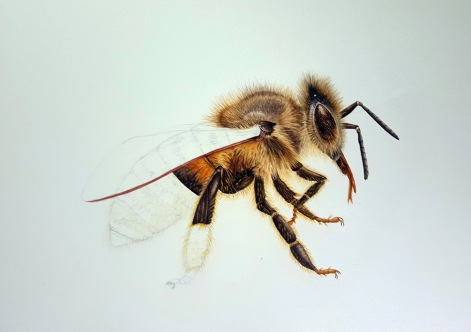
I began by going on a Honey Bee painting course with Cath Hodsman and learned a great deal about the insect, it’s behaviour and how a hive works.  I also studied them under a microscope. My painting of a honey bee is unfinished as yet but here it is so far.

honeybee
I then decided to go on Natures Details Butterfly course at the Kingcombe Centre, Dorset, run by Sarah Morrish. I chose to paint a Bedstraw Hawk Moth as it has rather beautiful colours that appeal to me. I have been asked by a couple of facebook followers to describe how I painted it. So, here goes!

I highly recommend the course to any interested in these beautiful insects. You will find details of Sarah’s courses on her website is : http://www.natures-details.com/index.html or on facebook at: https://www.facebook.com/NaturesDetailsArt/?fref=ts

20160802_080555

Painting a Bedstraw Hawk Moth

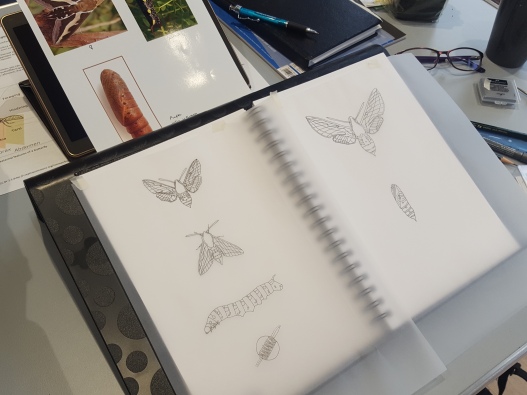
Firstly I drew up some illustrations in my sketchbook. To draw up the main moth on my composition, I drew up one half as accurately as I could with an H pencil. At this point I wanted to enlarge it slightly so I used proportional dividers to do this. My final drawing was x 1.5. I then traced this half and flipped it over to trace the other half of my moth. It’s not cheating! It just makes life easier and the drawing more accurately.

  Watch the curves, it may take a few attempts to get it just right!

  Take care to draw on details such as patterns, hairy parts, veins, eyes

  Check your drawing against the real sample regularly and adjust it as required

  Ensure both sides look as similar as you can get them, nature is not perfect but symmetry is very apparent in Moths and Butterflies

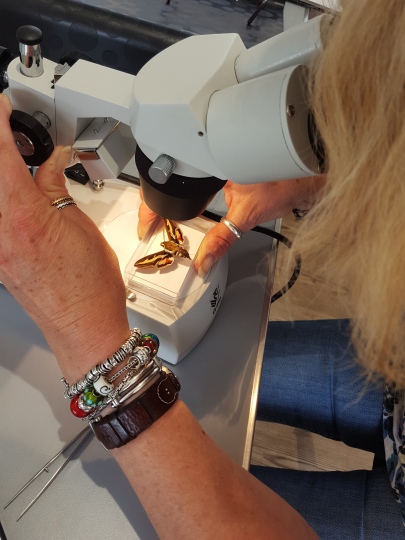
Using a microscope (x30) can help you to view moths/butterflies/bees more closely. When you look at them under a microscope it’s like another world! I saw the scales and hairs clearly and this helped me with my final paintings. I did the same on my honey bee painting above. It’s a great way to get all the information you need to make your painting more realistic. If you don’t have access to a microscope try using a very strong magnifying glass (x20)

20160804_152158

  Look all over the moth/butterfly, it’s very interesting and fascinating to see what the naked eye cannot see

  Look at the eyes and antenna, notice the way the eye is formed, the antenna can be patterned or they may have scales and hairs

I then looked at some books Sarah had left out for us and was particularly drawn to the Beatrix Potter wildlife one. She had painted small microscopic drawings of butterfly scales in her studies and this prompted me to do a series of illustrations showing the chrysalis, caterpillar, closed wing position, open (set) wing position and a microscope close up of the antenna. I took a look at the moths antenna under the microscope, it looked so interesting and completely different to what I had imagined. It reminded me of a hoover brush on one side and it was scaly on the other.

20160802_162032

Using a light pad/box to save time with tracings

Once the drawings were completed and as perfect as I could get them, I began to trace them off carefully with tracing paper using an F pencil (it needs to be a little darker to see the image on the light pad through the watercolour paper). I then cut up the tracings and played with composition arrangements for a little while until deciding on a more scientific arrangement. The microscopic view of the antenna determined this in my mind as I felt a scientific arrangement suited it better. I then stuck the illustrations into position on the light pad with masking tape being careful to watch the size of the gaps between each one. As my illustrations were forming a line vertically I used a long ruler to mark my centre line first. The gaps need to look comfortable and almost the same in size. I then placed my watercolour paper (HP 140lb (not heavier than this) quality watercolour paper) over the tracings on the light pad. I taped the watercolour paper into position so it didn’t move around and began to draw it very carefully with a 2H pencil. It’s good to use a very light pencil as you don’t want it to spoil your painting. This is especially important if you are painting light coloured plants or insects.

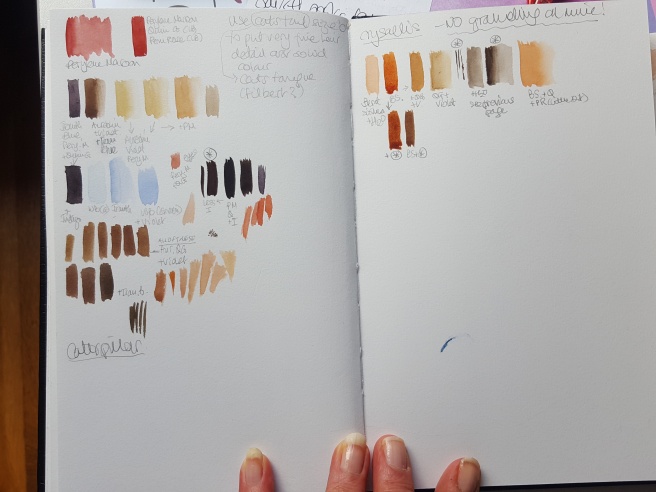
Now I’m ready to start mixing my colours and start painting! I always mix up my colours and tones and do test strips, checking the colours as I go. After that I copy them into my sketchbook and make a note of how I mixed the shades. I try to mix enough paint to use for the whole painting where possible. As you paint you may discover other tones that you need and mix them, make sure you put a dab of those in your book too. If you run out then you have a good idea of what colours you used to make them in the first place.

  Mix your colours carefully, match them against your subject

  Always make a note of the colours you’ve used to mix them with

  Use professional quality water colour paints

20160809_154442

I used a mix of warm colours to make up the colours for the Bedstraw Hawk Moth. You will have heard of warm and cool hues I’m sure. You can mix everything from just 3 colours, a red, a blue and a yellow. The colours will vary between warm and cool hues. You can make colour charts too if needed to help you. Many Botanical Artists have blogs explaining how to do this. For some very good examples and help with colour see Dianne Sutherland Ball SBA blogspot at: http://diannesutherland.blogspot.co.uk/2015/06/about-watercolour-paint.html

  Try out different mixes of colours so you have a good idea of what mixes what

  These are the colours I used to create my Bedstraw Hawk Moth: French Ultramarine, Indigo, Indanthrene Blue,Alizarin Crimson, Perylene Maroon, Permanent Rose,Violet, Quinacridone Gold, Windsor Lemon Yellow, Aureolin, Burnt Sienna

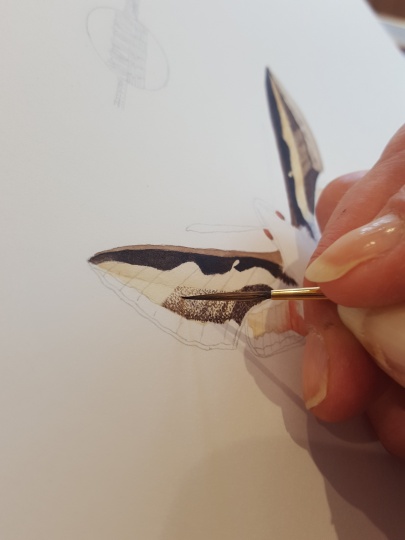
So now I have all my colours mixed up and I’m ready to start painting. I chose to do the wings first. I painted one part on both sides as I went, don’t be tempted to finish one side first! A few things to remember whilst you’re painting:

  Look at the different textures, some may be dotty, some hairy, some smooth

  Use a fine brush to do the stippling of dotty areas; a cats tongue brush, a spotter brush or I use a No. ‘0’ renaissance sable rigger

  Use a medium sized brush to do the washes, I use a Billy Showell No. 2 brush (there are other types but you need one which will hold the water well and has a fine pointed tip)

20160803_144612

  Build your painting up in thin layers, never put thick colour on to begin with. The colour should increase in strength as you go, building it up layers. At times my brown didn’t look warm enough so I laid a very watered down layer of Quinacridone Gold on top of it to warm it up

  Notice how the colours vary across the insect and try to imitate it, study it well before you start

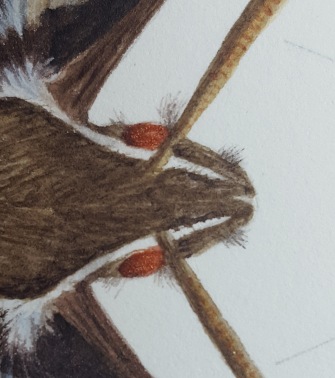
I decided to look at the eyes more carefully towards the end of my painting and found that they were iridescent. The Bedstraw Hawk Moth has coppery iridescence in its eyes. You can use a little iridescent paint to bring this out. Daniel Smith have a number of these available. Butterflies often have an iridescence on their wings too. My moth antenna close up has iridescence in blues and greens as well as creamy golds!

  Look at the hairyness and where it features on your insect. I found some eyelashes!

eyelashes

Always take time to paint your Moth or Butterfly as there is so much detail within. The closer you get to the original, the more realistic your painting will look. If you need any further advice please don’t hesitate to contact me at Jackie Isard Botanicals on facebook.

Good luck and I hope this has been useful!

*All photos, content, text and videos are subject to copyright – Jackie Isard Botanicals 2017

First blog post

This is my first blog! … and one of many more to come

This year I have been accepted to exhibit with the RHS. Very exciting for me! I am making a sketchbook specially dedicated to wildflowers and pollinators using it to study for my RHS entry in 2019. This blog will show how I develop the ideas and show my progress as I go along. I hope you enjoy it.

Recently I have become very passionate about wildlife and meadow wildflowers, as well as important pollinators. I’ve also been following Plantlife and their project to preserve our declining meadowland. This affects our Bees and wildlife and is of great concern. They are working very hard to ensure our wildlife and wildflowers are protected and I feel very strongly about this, so much so that I decided to choose this as my theme for my RHS project.

I’ve been visiting meadows these last few months to find plants of interest to my studies. It has opened up a whole new world to me. It’s like when you buy a new car, you suddenly notice loads of them on the road! I’ve seen wildflowers I’ve never seen before and wow! they are beautiful. As a botanical artist I’ve been studying them very closely and seen so much beauty in what many would call ‘weeds’. I’ve noticed insects I’ve never met and they’ve bitten me sometimes!

I’m looking forward to visiting Kingcombe meadow next week whist on a course with Sarah Morrish painting butterflies. A very knowledgable lady who I admire so much. She has been an inspiration to me.

Well, I’ll be back soon with my next blog soon. Enjoy!